
She Built Small - and Traveled Slow
A teardrop built in a borrowed garage taught Nora that small rigs make room for long mornings.
Their story
Nora's trailer began as a stack of plywood in her uncle's garage during the summer of 2020. She had never built a cabinet. Her uncle had, but believed instructions weakened character. The result was a five-by-eight-foot teardrop with a crooked hatch, excellent insulation, and a galley shelf that only stays level when the trailer does.
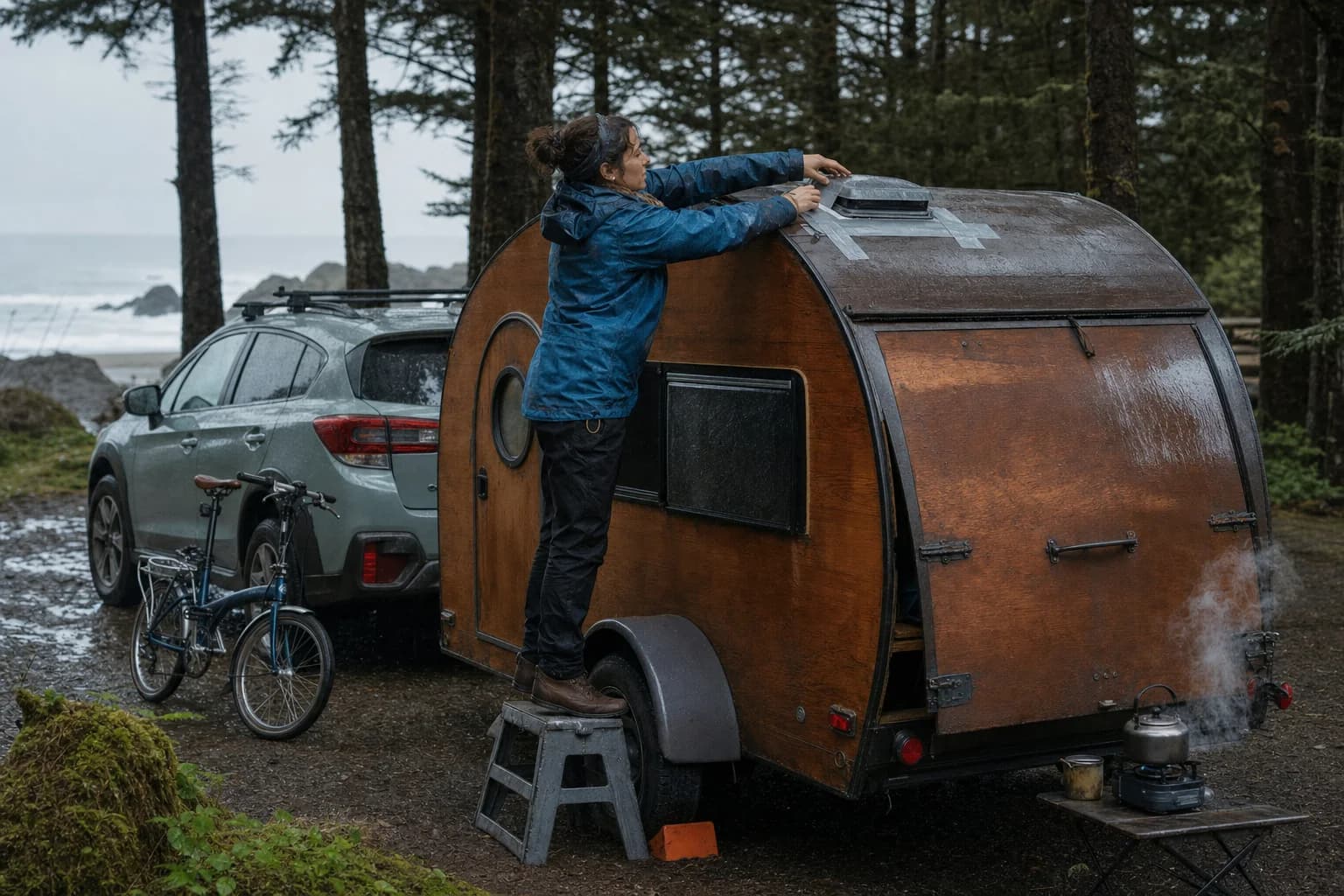
The first trip was to Seeley Lake. Nora arrived during a thunderstorm and discovered that her lovingly installed roof vent leaked directly above the pillow. She slept diagonally and repaired it with tape at breakfast. That minor failure removed the fear of ruining the trailer. It was already imperfect. She could use it.
Her travel style favors long weekends and old highways. She cooks outside, reads early, and keeps a folding bicycle inside the car. During wildfire season she changes plans quickly, checking air-quality maps before weather forecasts. One Labor Day she abandoned Idaho for the Oregon coast and found an empty county campground where the host sold firewood from a blue wheelbarrow.
People often ask when she will upgrade. Nora points out that the trailer fits in a standard parking space, costs little to tow, and makes bad roads feel less consequential. She would add a better hinge and perhaps six inches of headroom. Otherwise, small remains the point. Her next trip is not farther. It is slower: ten days along one river in Idaho, with no attempt to see what lies beyond it.
What a five-foot-wide trailer teaches quickly
A teardrop makes weather part of the itinerary. Cooking happens outside, shoes live near the door, and every wet item needs a plan. Nora began booking sites with a picnic shelter or windbreak when rain was likely. She also learned that a public library could rescue a cold afternoon without turning the trip into shopping.
The small trailer made detours easy. It fit ordinary parking spaces and did not punish the CR-V at every fuel stop. That freedom only worked because Nora resisted filling it. One skillet, one pot, one folding table, and one reliable rain layer did more for the trip than another storage box.
It is slower: ten days along one river in Idaho, with no attempt to see what lies beyond it.
Plan the journey
Turn their road into your route.
Use this as a starting itinerary, then adjust it for your rig, weather, pace, and current access rules.
- Trip length
- 13-15 days
- Approximate distance
- About 1,750 miles
- Best window
- Late September before heavy coastal storms
- Driving rhythm
- 150-220 miles with frequent two-night stays
- Booking strategy
- Reserve coast weekends; use inland state parks and forest campgrounds for flexibility
- Working budget
- $900-$1,400
Follow this route.
Drive estimates are planning numbers, not promises. Fuel, food, road work, and a trailer turn every map estimate into a longer day.
Missoula to Coeur d'Alene region
1 nightAbout 3 hours
Use a short first leg to verify the homemade trailer after highway travel.
Watch for: Recheck wheel temperature, coupler, and homemade cabinet fasteners.
Columbia River Gorge
2 nightsAbout 6 hours
Choose one base, visit waterfalls early, and leave the trailer parked for local drives.
Watch for: Wind can be strong enough to affect both towing and outdoor cooking.
North Oregon coast
3 nightsAbout 2 hours
Walk headlands, check tides, and use one rain day for town, reading, and drying gear.
Watch for: Salt air, sand, and wet bedding are small-rig problems that compound quickly.
Central coast
3 nightsAbout 2.5 hours
Move only far enough to change the character of the coast. Keep one day with no vehicle travel.