
When the Road Became the Classroom
A temporary year of learning outside school became a family archive of battlefields, beaches, and ordinary Tuesdays.
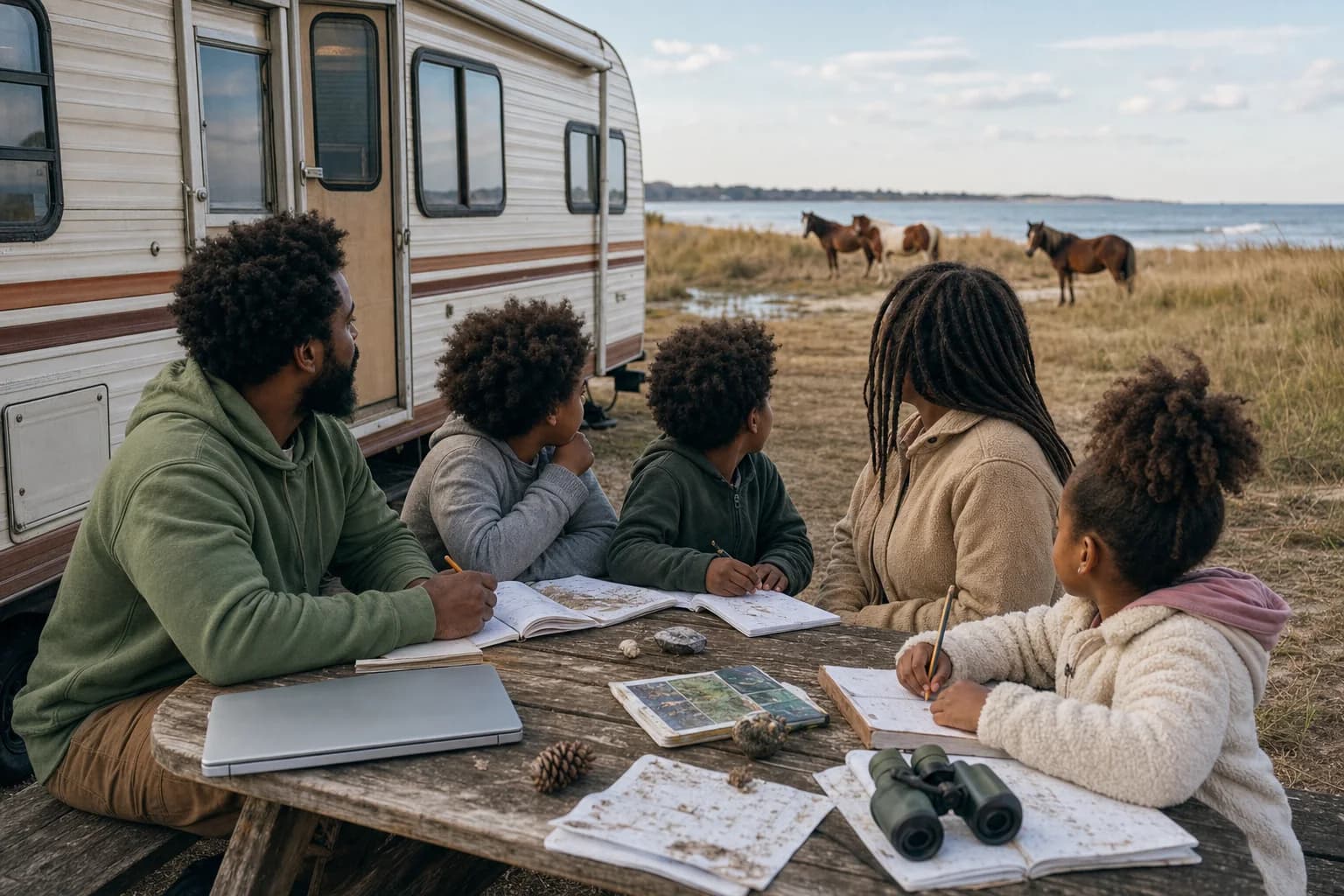
Their story
When school moved online in 2020, Alicia and Marcus bought a bunkhouse and imagined one semester on the road. Alicia could teach remotely. Marcus could manage his consulting work from a laptop. The children could learn American history near the places where it happened. The theory was elegant. The first week included three frozen video calls and a math worksheet lost to campground mud.
They adjusted. Mornings became school time, afternoons became walks, and travel days moved to weekends. At Gettysburg, Jordan asked questions that no textbook had prompted. At Assateague, the horses interrupted a lesson entirely. On election night in 2020, the family watched returns in a campground laundry room because it had the strongest signal.
After classrooms reopened, they kept the trailer and shortened the routes. The children returned to school, but long breaks still become chapters: civil rights sites in Alabama, coastal ecology in Georgia, geology in Utah. Marcus is careful not to describe every stop as educational. Sometimes the family needs a beach and no assignment.
The trailer has become a record of the children's ages. Pencil marks inside a pantry show their heights. A drawer contains Junior Ranger badges, ticket stubs, and a shell nobody claims. They no longer road-school. They simply travel with attention, which Alicia says may have been the lesson all along.
What worked when the road became the classroom
The Walkers began with a normal school schedule compressed into a trailer. It failed by Wednesday. They shifted to two core tasks before 10 a.m., one place-based question for the day, and reading at night. Museums and ranger programs stopped being rewards after worksheets and became the material itself.
Marcus and Alicia also learned that not every day needed an educational product. The children did not have to write about every battlefield or label every shell. Some experiences needed time before they became meaningful.
They simply travel with attention, which Alicia says may have been the lesson all along.
Plan the journey
Turn their road into your route.
Use this as a starting itinerary, then adjust it for your rig, weather, pace, and current access rules.
- Trip length
- 16-19 days
- Approximate distance
- About 1,450 miles
- Best window
- Late September, October, April, or early May
- Driving rhythm
- School mornings, site afternoons, travel every third day
- Booking strategy
- Reserve Assateague and weekend nights; use regional parks elsewhere
- Working budget
- $2,100-$3,300 for five people
Follow this route.
Drive estimates are planning numbers, not promises. Fuel, food, road work, and a trailer turn every map estimate into a longer day.
Durham to Williamsburg
3 nightsAbout 3 hours
Use one historic site per day and leave afternoon space for notes, swimming, or nothing.
Watch for: A full day of interpretation can exhaust children like a school day.
Richmond and Petersburg
2 nightsAbout 1 hour
Focus on a small number of sites and pair difficult history with time to talk.
Watch for: Do not reduce complex history to a scavenger hunt.
Washington region
4 nightsAbout 2 hours
Camp outside the core and use transit. Choose two museums, not seven.
Watch for: Parking the trailer in the city should not be part of the plan.
Gettysburg
3 nightsAbout 2 hours
Use the visitor center first, then a guided route or carefully paced self-drive.